

Class 1 Driving Course (Heavy Vehicle Combinations)
This driving course will teach you how to operate a Class 1 heavy vehicle on the road network safely, independently, cooperatively and responsibly.
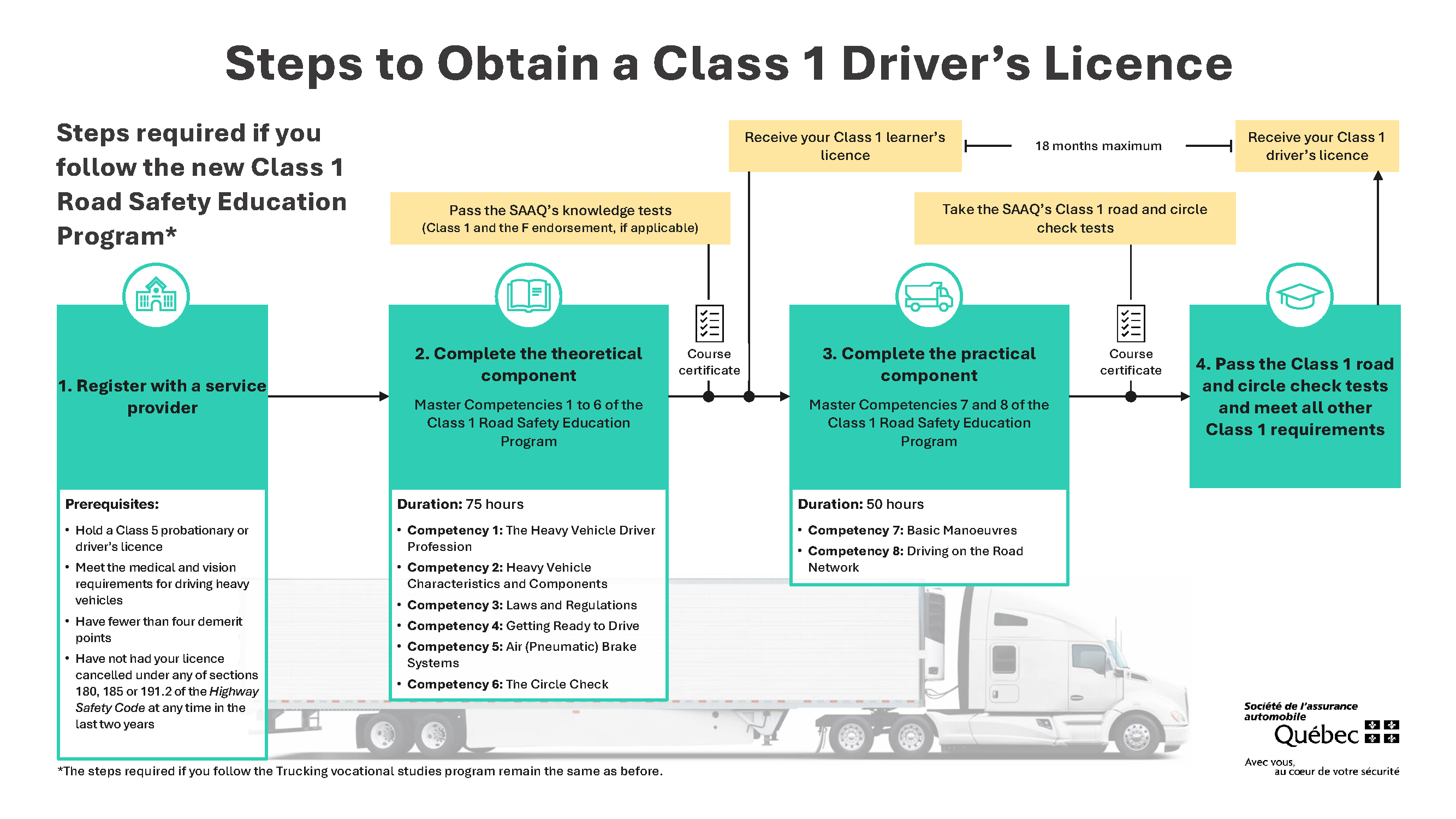
The course takes at least 125 hours to complete and is comprised of:
- a 75-hour theoretical component, divided into six competencies
- a 50-hour practical component that includes exercises in safe practice areas and on the road network, divided into two competences
To be eligible to take the course, you must hold a Class 5 (passenger vehicle) driver’s licence and have a good driving record. You can check your driving record online via your SAAQclic account.
Course structure
The Class 1 Road Safety Education Program employs an integrated competency-based approach. Each competency describes what you are expected to learn and the performance criteria upon which you will be evaluated.
The theoretical component of the course is provided online or in class by an instructor and covers several competencies. The goal of this part of the course is to teach you the basic notions you will need in order to drive a Class 1 combination of road vehicles. These notions and a variety of theoretical and hands-on exercises are included in the Driving a Heavy Vehicle guide.
Your mastery of each competency component will be evaluated in order to take stock of what you have learned and identify any areas needing improvement. This will also allow your instructor to follow your progress and provide support and additional exercises as required to help you improve.
This part of the course also gives you the opportunity to question certain driving habits you may currently have and think about the type of heavy vehicle driver you want to become.
The practical component of the course consists of a series of 34 exercises at the wheel of a semi-trailer truck. A total of 18 hours will be devoted to practising basic manoeuvres in safe practice areas, and another 32 hours will be spent driving on the road network. Before each exercise, your instructor will go over the manoeuvres you will be doing and the behaviour expected of you.
Time is also provided at the end of each exercise for a debriefing with your instructor. Self‑evaluation sheets are included to help you and your instructor assess how well you did based on specific performance criteria, and also identify your strengths and any issues you may have encountered. Your discussions with your instructor will help you find ways to overcome any issues, and the self-evaluation sheets will not only help you assess how well you are able to operate a semi-trailer truck, but will also provide you with another opportunity to get to know the type of heavy vehicle driver you are likely to become.
Theoretical component: 75 hours (minimum)
- Competency 1: The Heavy Vehicle Driver Profession
- Competency 2: Heavy Vehicle Characteristics and Components
- Competency 3: Laws and Regulations
- Competency 4: Getting Ready to Drive
- Competency 5: Air (Pneumatic) Brake Systems
- Competency 6: The Circle Check
You must complete the theoretical component of the course before you can take the knowledge test that you must pass in order to obtain your Class 1 learner’s licence. Refer to our website for more information: Heavy Vehicle Driver's Licence (Class 1).
Practical component: 50 hours (minimum)
You must have a Class 1 learner’s licence in order to do the exercises included in this part of the course.
- Competency 7: Basic Manoeuvres
- Competency 8: Driving on the Road Network
You must complete the practical component of the course before you can take the road and circle check tests you must pass in order to obtain your Class 1 driver’s licence. Refer to our website for more information: Heavy Vehicle Driver's Licence (Class 1).
 (PNG, 252.0 KB)
 (PDF, 427.9 KB)
Bridge courses for Class 2 or 3 licence holders
If you already hold a Class 2 (buses with a seating capacity of more than 24 passengers) or Class 3 (straight-body trucks) driver’s licence, you may be eligible to take a course that will allow you to bridge the gap between your current skills and abilities and Class 1 requirements, provided you have held your Class 2 or 3 licence for at least 24 months. These specially adapted bridge courses for Class 2 or 3 licence holders target only those competencies or competency components that are specific to driving heavy vehicle combinations, which means you do not have to take the entire Class 1 Road Safety Education Program. These bridge courses can also be further adapted to take into consideration any endorsements you have already obtained (the F endorsement for air brake systems or the M endorsement for manual transmissions). The SAAQ has developed these bridge courses to ensure that Class 1 candidates can follow training programs that fit their profile.
The bridge courses will take between 42.5 and 60 hours to complete, depending on your qualifications and experience.
F and M endorsement courses
If you already hold a Class 1 licence and want to obtain the F or M endorsement, the SAAQ has developed specially adapted mandatory courses for each endorsement. These special courses target only those competencies or competency components that are specific to the skills and abilities required, which means you do not have to take the entire Class 1 Road Safety Education Program.
These courses will take between 9.5 and 23.5 hours to complete, depending on your qualifications and experience, and the type of endorsement you wish to obtain.
SAAQ knowledge and road tests and obtaining a Class 1 driver’s licence
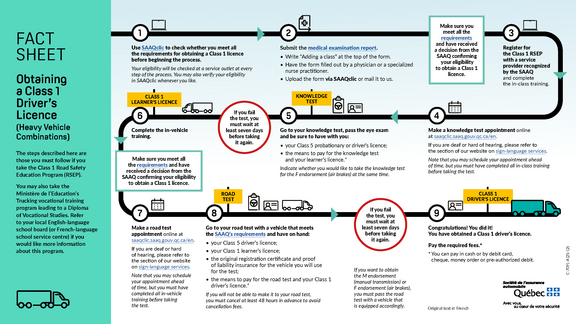
To prepare for the SAAQ’s knowledge and road tests, or for more information on the steps involved in obtaining a Class 1 licence, please refer to the Heavy Vehicle Driver's Licence (Class 1) web page and the fact sheet on obtaining a Class 1 licence.
Competencies
Note that each chapter in the Driving a Heavy Vehicle guide is associated with the corresponding competency in the Class 1 Road Safety Education Program. For example, Chapter 1 in the guide is associated with Competency 1 in the education program.
Competency 1 serves as an introduction to the heavy vehicle driver profession and provides an overview of various aspects of the transportation industry. It gives a breakdown of the various transportation categories and sectors that make up the transportation of goods, and explains the school transportation, urban transit and intercity transportation sectors that make up the transportation of passengers.
This competency also covers which class of driver’s licence you must obtain to be authorized to drive various types of heavy vehicles, and describes the typical tasks, knowledge, skills and abilities associated with the heavy vehicle driver profession.
Finally, an overview is provided of working conditions, job prospects, career opportunities and transportation industry partners.
While every vehicle has its own characteristics, the components used to operate the vehicle, control speed and maintain the vehicle on its course are similar from one vehicle to another.
As a professional driver, being very familiar with the vehicle you are diving is key to driving cooperatively, safely and responsibly.
Competency 2 covers the main characteristics of heavy vehicles and looks at how their different components and systems operate, including the brake system, the propulsion system and the various systems related to the vehicle’s handling.
Road safety is generally regarded as being in large part the driver’s responsibility. Accidents are more often caused by a driver’s behaviour than by the vehicle, the road or any other factor.
You must therefore do everything you can to avoid accidents. For starters, it is important to be very familiar with and obey the laws and regulations that govern road transportation. You must also adopt safe and defensive driving techniques while at the wheel of a heavy vehicle.
Competency 3 focuses on the various laws and regulations that apply when driving a heavy vehicle, including those that govern the transportation of goods or passengers and hours of driving and off-duty time. The road signs, traffic signals and pavement markings that apply specifically to heavy vehicles are also covered. This competency provides an overview of your obligations and rights as a heavy vehicle driver, as well as those of other road users.
Driving a heavy vehicle requires basic knowledge, regardless of the type of vehicle. You need to master the techniques that will allow you to control the speed and direction of your vehicle. Whether you are negotiating a curve, turning at an intersection, passing another vehicle or hitching or unhitching a semi-trailer, you need to know how to use the accelerator, steering wheel, brakes and transmission correctly.
In addition to these skills, you must learn how to observe your driving environment and adapt to it. Checking your blind spots, using your mirrors, signalling your intentions and maintaining adequate space around your vehicle are all habits that need to become second nature for you. These habits will help make sure you notice everything happening around you so that you can better assess complex driving situations and react optimally.
Competency 4 covers driving techniques you should use in special situations, such as when going up or down a slope or travelling on slippery roads. It also provides an overview of various behaviours and factors that can influence your ability to drive safely, cooperatively and responsibly while at the wheel of a heavy vehicle, including fatigue, speeding and distractions.
Competency 5 focuses on modern full air brake systems that are connected to all the vehicle’s wheels. It covers their components and how they function. While all air brake systems operate on the same basic principles, they vary slightly from one manufacturer to another and from one type of vehicle to another (depending on what the vehicle is used for).
All brake systems include service brakes, parking brakes and emergency brakes. By becoming familiar with the basics of how brake systems work, you will be able to inspect them properly and have a better chance of obtaining the maximum braking power in all situations.
Mechanical defects related mainly to brakes, tires, wheels, and coupling devices are a determining factor in more than 10% of heavy vehicle accidents. They also cause a significant loss of productivity in the carrier industry. And yet, most of these defects could be detected by properly inspecting a vehicle before it is used.
The aim of Competency 6 is to explain the circle check and ensure that a heavy vehicle’s main components get inspected. You will learn how to assess a heavy vehicle’s overall condition and identify any minor and major defects. This is important, as you may sometimes have to prevent a heavy vehicle from being used if its condition is likely to cause an accident or result in mechanical failure.
Competency 7 proposes a series of practical exercises to help you acquire the knowledge and skills that are essential to performing basic manoeuvres at the wheel of a semi-trailer truck, such as starting the vehicle, backing up and hitching and unhitching a semi-trailer. Each exercise lists objectives that are to be met in a particular learning environment. Additional information or specific instructions are provided in some cases to help you complete the exercises.
With these exercises, you will be putting into practice theoretical notions acquired in each of the previous competencies.
Once you have completed this competency, your level of mastery of each of the competency components associated with manoeuvring a semi-trailer truck will be evaluated.
Competency 8 focuses on helping you develop the skills required to drive a heavy vehicle on the road network safely, cooperatively and responsibly. Its numerous exercises will provide you with opportunities to practice driving in both light and heavy traffic, as well as in urban and rural settings and on limited-access highways. Instruction will also be provided regarding eco‑driving techniques, fatigue management and sharing the road with other road users.
Once you have completed this competency, your level of mastery of each of the competency components associated with operating a semi-trailer truck on the road network will be evaluated, based on specific performance criteria, with a view to assessing your level of readiness to take the Class 1 road and circle check tests.
Last update: January 27, 2026