

Particularities of Driving in Québec
Before getting behind the wheel, you must first become familiar with the particularities of the Highway Safety Code. This will help ensure you drive safely.
Driver's licence
To be allowed to drive in Québec, you must:
- hold a valid driver's licence with the appropriate class of licence for the type of vehicle you are driving and abide by the conditions that appear on the licence.
For example, a Class 5 licence is required to drive a passenger vehicle, such as a car.
If your driver's licence was issued outside Québec
You are allowed to drive on Québec roads for 6 consecutive months, but only an automobile, a motorcycle, a moped or a motorized scooter, provided your licence authorizes you to drive such vehicles.
If you decide to settle in Québec
You are required to exchange your foreign driver's licence for a Québec licence. You may apply for a licence exchange as soon as you arrive in Québec.
Go to the section entitled Foreign Driver's Licence for the procedure and conditions that apply to your situation.
When you drive in Québec
It is mandatory to have the following documents with you:
- a valid driver's licence
- the vehicle's registration certificate
- the vehicle's insurance certificate
Vehicle registration
To be authorized for road use in Québec, the vehicle – whether it is owned by you or borrowed from a friend or relative – must be registered and the fees to be authorized for road use must be paid.
There are several categories of licence plates based on vehicle type and use.
Insurance
Other than the rare exception, the owners of any vehicle travelling in Québec must be covered by a third-party civil liability insurance policy of at least $50,000 contracted from a private insurance company.
What are the particularities of the Highway Safety Code? It is important that you know them to avoid causing accidents or receiving a fine.
In Québec, we drive on the right side of the road
In Québec, as everywhere else in Canada or the United States, you must drive on the right side of the road.
Drinking and driving
In Québec, you are prohibited from driving a vehicle if your blood alcohol concentration is equal to or higher than 80 mg of alcohol per 100 ml of blood, or 0.08. This limit applies to holders of a driver's licence aged 22 or older.
Important! The zero-alcohol rule applies to drivers under age 22 and all new drivers (learner’s licence or probationary licence), regardless of their age.
To know more, visit the page Drinking and Driving – What the Law Says.
Drugs and driving
Just like with alcohol, driving while impaired by drugs (including cannabis and medication) is a criminal act.
While cannabis may be legal in Canada, you and your passengers are prohibited from smoking it inside a vehicle.
To find out more, visit the webpage Drugs and Medication – What the Law Says.
Speed limits on Québec roads
Speeds posted in kilometres per hour
In Québec, like everywhere else in Canada, speed limits are posted in kilometres per hour (km/h), and not in miles per hour (mph) as they are in the United States.
In towns and cities
The legal speed limit is 50 km/h. However, municipalities lower the speed limit in certain areas, for example in school zones, where the speed limit is usually 30 km/h. Watch for signs!
On secondary roads
The speed limit is usually 90 km/h. However, on certain roads, the speed limit can be 80 km/h, 70 km/h or lower. Keep your eyes open!
On most highways
The speed limit is 100 km/h, and not 130 km/h as it is in several European countries.
Fines and penalties for speeding in Québec
Speeding leads to demerit points and fines that vary based on how much faster than the speed limit you were driving.
Seat belts
Seat belt use is mandatory for all automobile passengers (riding in both the front and rear).
Child car seats
The law requires that children be properly secured in a car seat that is adapted to their weight and height until they are 145 cm tall or 9 years old. We recommend that you continue to have your child use a booster seat until you are certain that the seat belt alone can be used correctly.
A seat belt can be used correctly when both of the following conditions are met:
- when children are seated, their backs are flat against the seat’s backrest, with their knees bent over the edge of the seat
- when buckled up, the seat belt lies across the middle of their shoulders (collarbone) and across their hips (pelvis)
Back seat
It is recommended that children aged 12 or younger ride in the back seat.
Child car seat stages
Rear-facing seats
- For newborns and infants until they weigh at least 10 kg (22 lb)
Front-facing seats
- For children who are at least 1 year old, who weigh at least 10 kg (22 lb), and who are able to maintain an upright position on their own
Booster seats
- For children who weigh at least 18 kg (40 lb).
- The booster seat raises the child so that the car's seat belt lies across the middle of the shoulder (not the neck) and across the hips (not the stomach)
Traffic lights
In Québec and elsewhere in Canada, as in the United States—everywhere in North America in fact—red, amber and green traffic lights are located on the other side of the crossing, not at the stop line right in front of your car.
Remember that you do not stop at the foot of the lights, which would mean that you would have already crossed the intersection. It would already be too late for you and the other road users.
Right turns on a red light
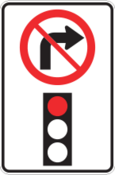
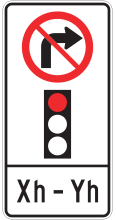
Turning right on a red light is permitted in Québec, except on the island of Montréal and where prohibited by signs posted at intersections.
Always check the signs on the traffic light in question. In some cases, the sign indicates the times during which right turns on a red light are allowed or if you are prohibited from doing so.
When right turns on a red light are permitted, you must stop your vehicle, just like you would at a stop sign, and make sure you can turn safely before executing the manoeuvre.
To properly understand the principle of right turns on a red light, visit the relevant section.
Flashing green light or green arrow (flashing or not)
This type of light is commonly used in Québec. When the green light flashes or a green arrow appears, this means that you have the right of way to turn left. The vehicles on the other side of the intersection are not allowed to move forward, since their light is red.
Turning left: caution! You have to turn IN FRONT of the car on the other side
Something else that may surprise you: when turning left at an intersection, if vehicles facing you are also turning left, you have to turn in front of those vehicles – not turn behind those vehicles, as is done in Europe, Asia and Africa.
Other particularities
No left turns
You may encounter two road signs that both mean the same thing, indicating that turning left is prohibited, in Montréal in particular.
These signs are the following:
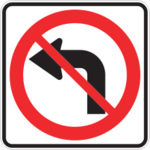 No left turns
- OR
 Straight ahead or right turns only
3- or 4-way stop signs: who goes first?
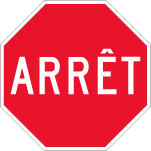
Stop signs are everywhere in Québec and the rest of North America. At intersections, you will often see 4-way stop signs (marked “ARRÊT”).
The rule is: the first car to stop is the first to go, and so on.
Four-way stop signs
Stop signs (marked "ARRÊT" in Québec) are everywhere in Québec and the rest of North America. The rule is: the first vehicle to stop is the first to go, and so on. You must also yield the right of way to pedestrians already in the intersection.
School buses: when the red lights are flashing, stop right away!
Easily recognizable by their yellow colour, school buses must be taken seriously.
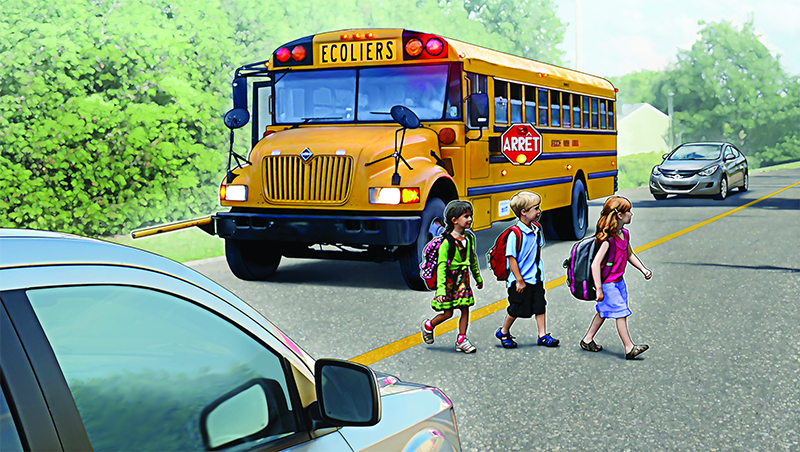
Namely:
- When their red lights are flashing and the stop signs are deployed on the side of the bus, you must immediately come to a complete stop, regardless of whether you are following or meeting the bus from the opposite direction. You may only continue once the flashing red lights are off and the stop sign is retracted. This rule does not apply when there is a median wall between your vehicle and the bus.
- You must bring your vehicle to a stop at least five metres away from the bus. This allows school children to cross the road to get on the bus or get home.
Failing to stop, in either direction, when a school bus's red lights are flashing is one of the most severely punished offences.
Using the horn
In Québec, horns are only used when justified by a particular situation. A horn must not be used to express one's anger, impatience or other mood. Even at weddings, horn concerts are not appropriate.
In the event that you feel compelled to honk your horn for no valid reason, you could be subject to a fine of at least $100.
Buffer lanes: caution!
When an emergency vehicle, a tow truck or a surveillance vehicle is stopped by the side of the road and its yellow arrow signal light or its rotating or flashing lights are activated, you must create a buffer lane. You are required to slow down and move over to increase your distance from the stopped vehicle as much as possible, after making sure you can change lanes without causing an accident. If it is not possible to move over safely, you must stop and wait before driving around the stopped vehicle to avoid posing a risk to the lives or safety of others.
Offenders face a fine of $200 to $300, in addition to other costs, and 4 demerit points.
To find out more, visit our page on the Move-Over Law.
Road Work Zones
In road work zones, you must obey the orange signs and slow down to comply with the posted speed limit. Doing so is essential to ensure the safety of workers and avoid fines and demerit points. Fines are doubled in the case of a speeding offence.
To find out more, visit our page on Road Work Zones.
Winter driving
In Québec, from December 1 to March 15, your vehicle must be equipped with four winter tires in good condition, otherwise you are committing an offence. You must also clear the snow off of your entire vehicle (windshield, windows, mirrors, roof, hood and lights) to have good visibility. You must also reduce your speed when visibility is reduced under conditions of darkness, fog, rain or other precipitation, or when the roadway is slippery or not fully cleared, etc.
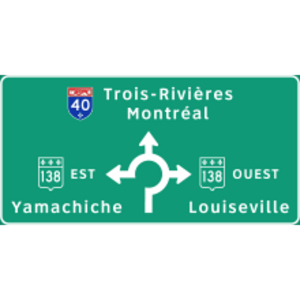
Roundabouts
Roundabouts, also known as traffic circles or rotaries, are intersections made up of a central island around which 1, 2, 3 or 4 traffic lanes merge in a star-shaped pattern. Roundabouts encourage speed reduction, contribute to reducing the number and severity of accidents and regulate the flow of traffic, as vehicles enter the roundabout only when the way is clear.
Basic principles
- Slow down when approaching a roundabout.
- Always enter a roundabout to your right and move in a counter-clockwise direction.
- Yield the right of way to drivers, cyclists and pedestrians who are already in the roundabout.
- If there are pedestrian crosswalks, yield the right of way to pedestrians.
We recommend that you learn more about the proper manoeuvres on the site of the Ministère des Transports (page in French only).
Impaired driving
A person's ability to drive can be compromised by alcohol, drugs or certain medications, which increases the risk of accidents. If you are found guilty of a criminal offence for alcohol- or drug-impaired driving, it may be difficult for you to enter the United States or to find work. A criminal conviction can be very expensive, meaning thousands of dollars.
Speed
Speed is one of the leading causes of accidents on Québec roads. A speeding offence can lead to demerit points and a fine. Your driver's licence will be suspended if you commit an excessive speeding offence and your vehicle could even be seized (towed away) and impounded.
Fatigue
Rolling down the window, turning up the radio, singing, chewing gum or talking to passengers are not effective solutions when you are tired. When the first signs of fatigue begin to appear, the best solution is to stop to take a 15- to 30-minute nap and to drink a cup of coffee before setting off again. The nap is not a substitute for a good night's sleep, but it will help you continue your trip safely for a while.
Cell phones and texting
Using a cell phone or any other portable electronic device while driving is prohibited. Simply holding a device in your hand or in any other manner while driving is prohibited, even if you are waiting at a red light or stuck in a traffic jam.
To use your cell phone or any other portable electronic device, park at a location where it is safe and legal to do so. You may, however, use hands-free devices while driving.
Cycling
Watch out for cyclists and anticipate their presence on the road. Cyclists must sometimes leave the far right side of the road to avoid obstacles.
Keep your distance: the Highway Safety Code requires that, when passing a cyclist, you slow down and keep a distance of 1 metre between your vehicle and the cyclist in zones of 50 km/h or less, and 1.5 metres in zones of more than 50 km/h.
At intersections, before turning, watch out for cyclists, check your blind spots and yield the right of way to cyclists.
When parked, before opening your car door, make sure that no cyclists are approaching.
Pedestrians
In Québec, all road users have a duty to be careful and considerate when travelling on a public highway, especially toward more vulnerable road users.
Watch out for pedestrians, particularly at intersections where they gather in greater numbers. It is also important to anticipate their presence at pedestrian crosswalks and near other locations where pedestrians are likely to be (schools, hospitals, playgrounds, commercial establishments, etc.). Be sure to:
- stop in front of the stop line at intersections and pedestrian crosswalks
- respect the right of way of pedestrians at intersections, pedestrian crosswalks and before entering or exiting a private driveway
- obey traffic signs and signals that concern pedestrians, such as pedestrian lights
- make eye contact with pedestrians who want to cross the street and make a hand gesture to let them know you have seen them
Prohibition
- Indicates that anything within the circle is prohibited.

Obligation
- Indicates that anything within the circle is compulsory.

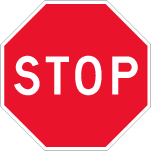
Stop
- Indicates that you must come to a full stop at an intersection.
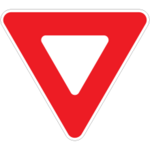
Yield
- Indicates that you must yield the right of way to vehicles already travelling in the lane.
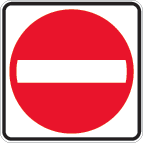
Do not enter
- Indicates that access to a road is prohibited for all vehicles.
One-way traffic
- Indicates that traffic is allowed only in the direction indicated by the arrow.

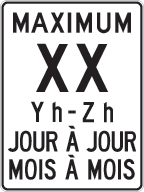
School zone
- Indicates the beginning of a school zone. A speed limit sign accompanies this sign and indicates the speed limit in the school zone, as well as the times, days and months the speed limit is in effect.
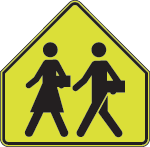
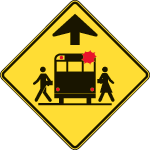
School bus stop ahead
- Warns of the possible presence of a school bus that has stopped to take on or let off passengers.
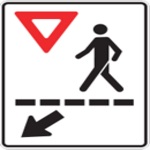
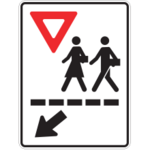
Pedestrian crosswalks
- Indicates the presence of a pedestrian crosswalk. You must yield the right of way to any pedestrians who have stepped into the crosswalk.

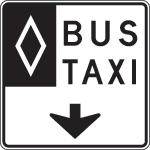
Reserved lane
- Indicates that a lane is reserved for certain types of vehicles (buses, taxis).
Traffic lights
- The red light means you have to bring your vehicle to a full stop. The vehicle must stop before the stop line.

Prohibition from turning right on a red light
- These signs are found at intersections where turning right on a red light is prohibited. The sign may indicate the times during the day when this prohibition applies.
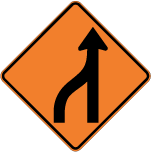
Lane merge
- Indicates that two or more lanes merge into one lane.
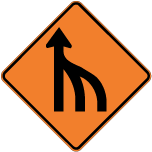
Road work signs
- Indicates the distance to a road work site.
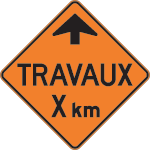
Road work signs
- Indicates the presence of a flagperson ahead directing traffic with a sign used to slow down or stop traffic near a road work site.

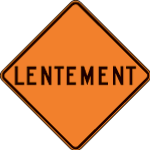
Last update: October 5, 2026