

Full-body sectioning and structural repairs
Since June 18, 2018, road vehicle inspection agents have been required to follow updated procedures when making technical appraisals of severely damaged and rebuilt vehicles. These procedures aim to ensure the safety of rebuilt vehicles and compliance with the Highway Safety Code .
Highway safety code
The Highway Safety Code requires that:
- vehicles be repaired in such a way as to provide occupant protection that is comparable to the protection existing when the vehicle was manufactured
- structural components be repaired and assembled according to the manufacturer’s specifications using methods that do not affect the mechanical and physical properties of the materials
- the body assembly points be in the places determined by the manufacturer
- the assembly points be accessible and clearly visible when the technical appraisal is made
For more information about the procedures, consult the Questions & Answers – New Procedures for the Technical Appraisal of a Vehicle (PDF, 210.1 KB).
Technical appraisal
Full-body sectioning (clipping) consists of cutting a monocoque vehicle in two so as to replace the damaged rear section with the rear section from another vehicle. Given the technical advances in automobile engineering, manufacturers no longer authorize this procedure because it poses a risk to occupant safety.
This type of repair is refused in the technical appraisal. Vehicles will be thoroughly inspected for any evidence of full-body sectioning.
Modern vehicles are built with an increasing number of structural parts that are designed and assembled in such a way as to ensure occupant safety in the event of a collision. When such structural parts are damaged, regardless of whether they are made of mild or high-strength steel, they must be repaired according to the manufacturer’s specifications to maintain the integrity of the vehicle’s safety features.
Using heat to straighten structural parts is prohibited, given that heat can affect the mechanical and physical properties of the material, thereby compromising vehicle safety.
Manufacturers generally do not authorize the straightening of parts made of high-strength steel (700 MPa and higher). These parts could crack in the straightening process and potentially break in a subsequent accident. Straightening them could also damage adjacent parts. In cases where manufacturers do not authorize parts made of high-strength steel to be straightened, the damaged parts must be replaced according to the manufacturer’s instructions.
Structural parts used to absorb kinetic energy in a crash cannot be straightened and must be replaced. This is the case, for example, of a side rail or a centre pillar that has been crumpled or bent.
With the manufacturer’s authorization, a structural part can be sectioned and partially replaced. However, the methods recommended by the manufacturer must be followed when it comes to assembling the replacement section and determining the placement of assembly points.
Before beginning any repairs, rebuilders should always refer to the manufacturer’s repair specifications for the year and model of the vehicle they wish to repair to avoid repairs being rejected in the technical appraisal.
Rebuilders must follow the manufacturer’s instructions for any structural parts that require repair, straightening or partial replacement. Road vehicle inspection agents must ensure that rebuilt vehicles are compliant. For this purpose, we recommend you bring the instructions you followed to rebuild the vehicle to your technical appraisal appointment. If the instructions are not provided, incomplete or have to be checked, it is the road vehicle inspection agent’s duty to obtain them, which can prolong the technical appraisal process and generate additional costs. Repairs that were not made according to the manufacturer’s instructions will be declared non-compliant.
If access to the repair instructions is only given to repair shops certified by the manufacturer, which is the case for some luxury vehicle manufacturers, structural repairs must be made by one of the manufacturer’s certified repair shops. In this case, the shop must issue a detailed invoice, provide photographs of the repairs and confirm that they were made according to the manufacturer’s specifications.
Regulations require that assembly points be accessible and clearly visible at the time of the technical appraisal; however, this is often not possible. In this case, photographs of the assembly points can be submitted to the road vehicle inspection agent.
The submitted photographs must document each assembly point at each stage of the assembly. For example, if you replace a rocker panel reinforcement, you must provide at least one photograph of the installation and another one of the replacement rocker panel backing plate. To ensure that your photographs document all the repairs and identify the vehicle, you may need to take both panoramic and close-up photographs.
Remember that the submitted photographs must allow the road vehicle inspection agent to confirm that the structural repairs meet the manufacturer’s specifications. Rebuilders must provide clear photographs in sufficient number, otherwise the vehicle may be deemed non-compliant by the inspection agent. Plenty of step-by-step photographs of all assembly points should be taken before completion to adequately illustrate the repairs and avoid any issues in the technical appraisal.
If a part that was identified for replacement in the damage appraisal was repaired instead, the rebuilder must provide clear photographs that document the repair for the technical appraisal. These photographs must show the initial condition of the part and demonstrate that the repairs meet the manufacturer’s requirements. In this situation, a copy of the applicable manufacturer’s specifications must also be submitted.
The assembly points must be clearly illustrated in 15 x 10 cm or larger colour photographs. When taking the photographs of the repaired vehicle, you must include a piece of paper on which you have clearly written the date and the last 8 characters of the vehicle identification number as shown in the example below.
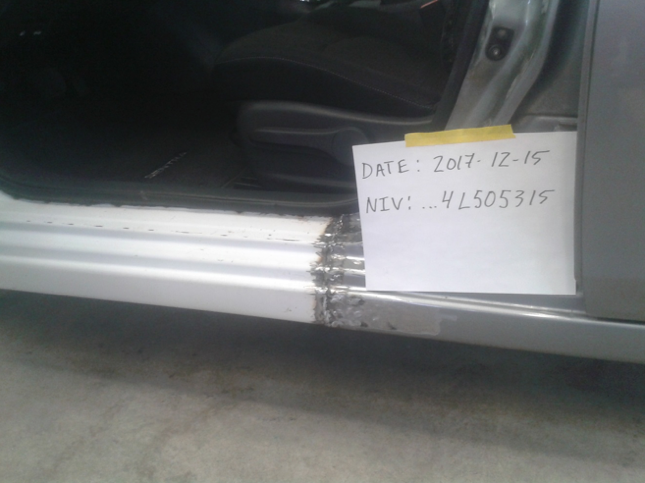
If the assembly points are no longer visible or accessible at the time of the technical appraisal, photographs meeting the aforementioned criteria must be submitted; otherwise, the road vehicle inspection agent will be unable to verify whether the repairs meet the applicable standards, and the vehicle will be declared non-compliant.
Front side rail
A front side rail is damaged and must be replaced. Given that it is made of high-strength steel, it cannot be heated and straightened.
If you wish to replace only the front section, you must check whether the manufacturer has developed a procedure for partial replacement. If so, the side rail must be cut where specified by the manufacturer and assembled following the recommended methods. If the manufacturer does not allow for partial replacement, the entire side rail must be replaced following the manufacturer’s specifications. A copy of the manufacturer’s procedures must be provided at the time of the technical appraisal, as well as photographs of the assembly points if they are no longer visible at the time of the appraisal.
Roof replacement
You must first find out whether the manufacturer’s specifications allow for the sectioning of the A, B and C pillars. If the manufacturer authorizes the sectioning of each of these pillars, the entire roof can be replaced. However, the pillars must be cut where specified by the manufacturer and the new roof must be assembled following the recommended methods. If the sectioning of one or more pillars is not allowed, the roof will have to be taken apart at the original assembly points. Installation of the new roof must meet the manufacturer’s specifications. A copy of the manufacturer’s procedures must be provided at the time of the technical appraisal, as well as photos of the assembly points if they are no longer visible.
Pillar replacement
When replacing a pillar, you must check whether the manufacturer allows for the partial replacement of the pillar, or requires that the entire pillar be replaced.
In both cases, the repairs must be made in accordance with the manufacturer’s instructions.
A copy of the manufacturer’s specifications must be provided at the time of the technical appraisal, as well as photographs of the assembly points if they are no longer visible.
Straightening of structural parts
Before repairing a structural part, you need to check whether this is authorized by the manufacturer. Some manufacturers prohibit repairs to structural parts, while others accept them provided they are made in accordance with specific criteria. Parts made of high-strength steel often cannot be repaired and must be replaced.
Assembly
The manufacturer’s specifications indicate how the various components should be assembled. These assembly instructions must be followed. Spot welding, MIG brazing, or MIG welding with wire specifically for high-strength steel may be required. For any structural repairs requiring welding, a welding certificate attestation de soudure (PDF, 144.9 KB) (in French only) must be presented at the time of the technical appraisal. Some vehicles require the use of specific rivets, adhesives and tools. In this case, itemized invoices must be submitted along with photographs of the assembly process.
Access to manufacturers’ repair specifications
The OEM1Stop website provides an information portal that can help you access major automobile manufacturers’ repair specifications. Once you have been redirected to the website of the applicable manufacturer, the information you require can be obtained free of charge or for a small fee.
General information can also be obtained in the OEM Partial Part Replacement Search section of the I-CAR website. Simply choose the vehicle to be repaired from the drop-down lists. For specific repair procedures however, you must visit the manufacturer’s website.