

Electric Scooters and Other Motorized Personal Mobility Devices
The three-year pilot project on motorized personal mobility devices launched on July 20, 2023 by the Ministère des Transports et de la Mobilité durable has been extended until July 20, 2028. This project replaces two other pilot projects concerning electric scooters that tested a more limited number of devices.
The pilot project aims to:
- test the use of such devices under certain conditions and on certain public roadways, including bike lanes
- assess the integration of such devices into road traffic
For more information, please visit the Québec government's web page on Rules for using electric scooters and other motorized personal mobility devices | Gouvernement du Québec.
Devices covered by the pilot project
Intended for the transportation of people, motorized personal mobility devices are vehicles that:
- are equipped exclusively with electric motors
- are equipped with at least one wheel
- do not have a cabin that is enclosed using a rigid or soft or transparent or opaque material
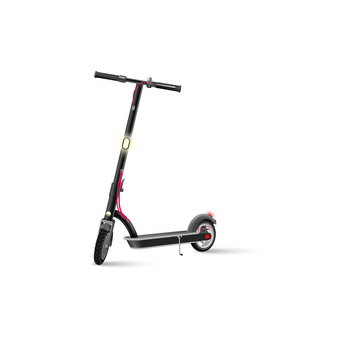
The following types of vehicles are covered by the project: electric scooters, gyroscopic vehicles (also known as self-balancing vehicles) and vehicles similar to scooters but with a seat or three wheels.
Examples of an electric scooter and a gyroscopic vehicle:

Rental vehicles, including those offered through a self-rental service, are also covered by the project and subject to the associated obligations.
Motorcycles, mopeds and scooters (other than electric scooters), power-assisted bicycles, motorized mobility aids, motorized toy vehicles and off-road vehicles are not considered motorized personal mobility devices for the purposes of the pilot project.
Authorized operation
Under the pilot project, these devices can be operated on public roadways, private roads open to public vehicular traffic, shopping mall parking lots and other property where public traffic is permitted.
Mandatory characteristics
To be authorized for use on these roadways, motorized personal mobility devices must meet the following criteria:
- the device's drive effect must cease when it has reached a speed of no more than 25 km/h
- the device must weigh no more than 36 kg, including the battery
- the device must have one or more wheels, each with an overall diameter of at least 190 mm
Mandatory equipment
Brakes
The braking system must meet the following requirements:
- Each wheel must be equipped with a brake enabling the device to stop quickly and effectively on a dry, paved and level roadway:
- An electric motor equipped with a wheel that allows it to stop the device quickly and effectively on a dry, paved and level roadway is considered a brake.
- With the exception of gyroscopic vehicles, the device must be equipped with at least two braking systems activated by separate controls, at least one of which must be mechanical:
- If the device is equipped with handlebars, one of the mechanical braking systems must be activated by hand.
Headlights, lights and reflectors
The device must be equipped at all times with:
- a red reflector or red reflective material on each side, as far to the rear as possible
- a white reflector or white reflective material at the front
- a red reflector or red reflective material at the rear
The device may be exempt from this requirement if the user wears clothing or an accessory (backpack, helmet) with reflective material that is visible to other road users.
Considering that the device's headlights and other lights must remain on at night while the device is in use, the device must also be equipped with:
- a white headlight or white light at the front, which may be a flashing light
- a red taillight, which may also be a flashing light
The device may be exempt from this requirement if the user wears a light device that replaces the above lights and that is visible to other road users.
The reflectors, reflective material, headlight and lights must be:
- visible from at least 150 metres away
- kept free of any obstructing matter that reduces their effectiveness.
Traffic rules
The traffic rules that apply to users of motorized personal mobility devices are generally similar to those that apply to cyclists, namely:
- they must stay as close as possible to the edge or right side of the roadway and travel in the same direction as traffic
- they must travel in the same direction of traffic if travelling on the shoulder
- unless expressly permitted, they must not use their device on a sidewalk
- they must yield the right of way to pedestrians at pedestrian crosswalks
- they must comply with the road signs, traffic signals and pavement markings that apply to cyclists
However, certain special rules apply when using a motorized personal mobility device.
Users of motorized personal mobility devices must:
- be at least 14 years old and have on hand a document that can prove their age
- signal their intentions unless they are unable to safely do so
- wear a protective helmet that is correctly adjusted and firmly attached
- wear the following protective equipment when using a device that does not have handles:
- elbow pads
- knee pads
- gloves or other safety gear that protects the rider's hands and wrists
- closed shoes
Users of motorized personal mobility devices must not:
- travel on public roadways where the speed limit is over 50 km/h
- drive at speeds of over 25 km/h
- wear earbuds or headphones
- carry passengers
- travel with an animal or object blocking their view or impeding the operation of the device
- pull a trailer
- pull or push any other object or person
- use a cell phone or any other portable device, unless:
- the cell phone or portable device is adequately and safely mounted on the mobility device and is only used to display travel information or information related to operating the mobility device’s equipment
- the user is stopped on the side of the roadway or on the shoulder in such a way that does not obstruct traffic
Offences
Users of motorized personal mobility devices who fail to comply with the pilot project’s rules are liable to a $100 or $200 fine.
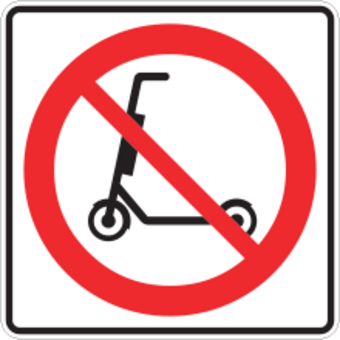
Road sign
During the pilot project, a person responsible for maintaining public roadways may use the sign below to prohibit the use of motorized personal mobility devices on a bike path or public roadway.
Provisions that apply to other road users
Road users must treat users of motorized personal mobility devices the same way they would cyclists. For example:
- a driver or cyclist who is turning at an intersection must yield the right of way to any user of a motorized personal mobility device who is crossing the roadway the driver or cyclist is about to enter
- when approaching and passing a user of a motorized personal mobility device who is in the same lane, a driver must slow down and keep a distance of at least one metre
- a driver following a user of a motorized personal mobility device must remain at a safe and reasonable distance, taking into account speed, traffic density, weather and road conditions
Information sheet
The Ministère des Transports et de la Mobilité durable has prepared an information sheet summarizing the main rules and obligations for users of motorized personal mobility devices. You can find it on the following web page: Rules for using electric scooters and other motorized personal transport devices .
Last update: October 9, 2026